Sign Up with Epic Games


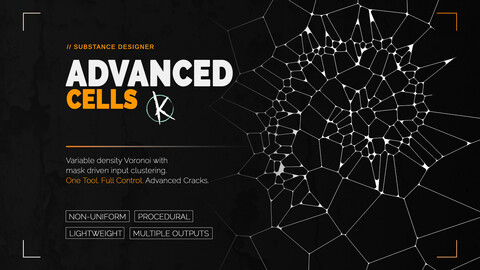
Advanced Cells
A custom Voronoi cells node for Substance Designer that gives you full control over cell distribution through an input mask. Drive density, clustering, and scale per region instead of being locked into the uniform output of the default Cells nodes.
Core feature: Mask-driven distribution
Feed any grayscale mask into the input and the node redistributes Voronoi points based on the mask values. Multiple modes let you choose how the mask influences the pattern:
- Density modulation: more points where the mask is bright, fewer where it is dark
- Cluster mode: pulls points toward bright areas to form tight groups with sparse surroundings
- Scale variation: changes cell size locally based on mask intensity
- Inverse modes for each, so you can flip the behavior without pre-inverting the mask
- Non-uniform edge distribution for even more organic patterns
Outputs
Multiple outputs ship with the node so you do not have to rebuild the same patterns downstream:
- Cell pattern (filled)
- Cell edges (crack pattern)
- Distance field
- Cell ID / random per-cell grayscale
- Crystallized
- Masked Cells
Use cases
- Non-uniform cracks that follow stress maps, curvature, or hand-painted guides
- Localized shattering and damage that concentrates around impact points
- Stylized rock, dirt, and organic surfaces where uniform Voronoi reads as fake
- Procedural foliage scatter, pebble distribution, and tile variation driven by terrain masks
- Sci-fi panel breakups and tech surface detailing
Why it matters
The default Cells nodes in Substance Designer produce evenly spaced points. Every workaround involves stacking warps, slope blurs, and tile samplers to fake non-uniformity, which is slow to author and slow to cook. Advanced Cells solves this at the source. One node, one mask, full control.
CATEGORIES
Standard Licence
USD $7.99
License: Standard License
Stock Assets
For personal use and one commercial project (up to 2,000 sales or 20,000 views).
TutorialsOne copy to be used by a single user.
Installable ToolsOne installation by a single user.
Learn MoreSingle non-commercial user. This license does NOT apply to companies. Read MoreRead Less
Files (1)
Small Business License
USD $19.99
License: Extended Commercial License
Stock Assets
For use on an unlimited number of commercial projects with no limits on sales or views.
Learn MoreApplies to companies or schools with revenues UNDER $100K. Read MoreRead Less
Files (2)
Studio License
USD $34.99
License: Extended Commercial License
Stock Assets
For use on an unlimited number of commercial projects with no limits on sales or views.
Learn MoreCommercial Use / Unlimited Users ➔ This license is for use on an unlimited number of commercial projects with no limits on sales or views or for companies or teams where multiple people will use the product. ❌ You do not have the right to resell and publish the product for free. Read MoreRead Less
Files (2)
https://artstn.co/m/RyaOn
Copied
More by Kai "Kizzle" Mergener
Add a tip for Kai "Kizzle" Mergener
Tips are appreciated, but optional!