
 Sign Up with Epic Games
Blender to Unreal Engine 5: Build a Stylized Greek Island Environment

in Tutorials



Create the Final Image—and Understand the Production Behind It
This course follows the complete creation of a bright, stylized Greek-island-inspired village, from the first reference and blockout in Blender to the final cinematic environment in Unreal Engine 5.
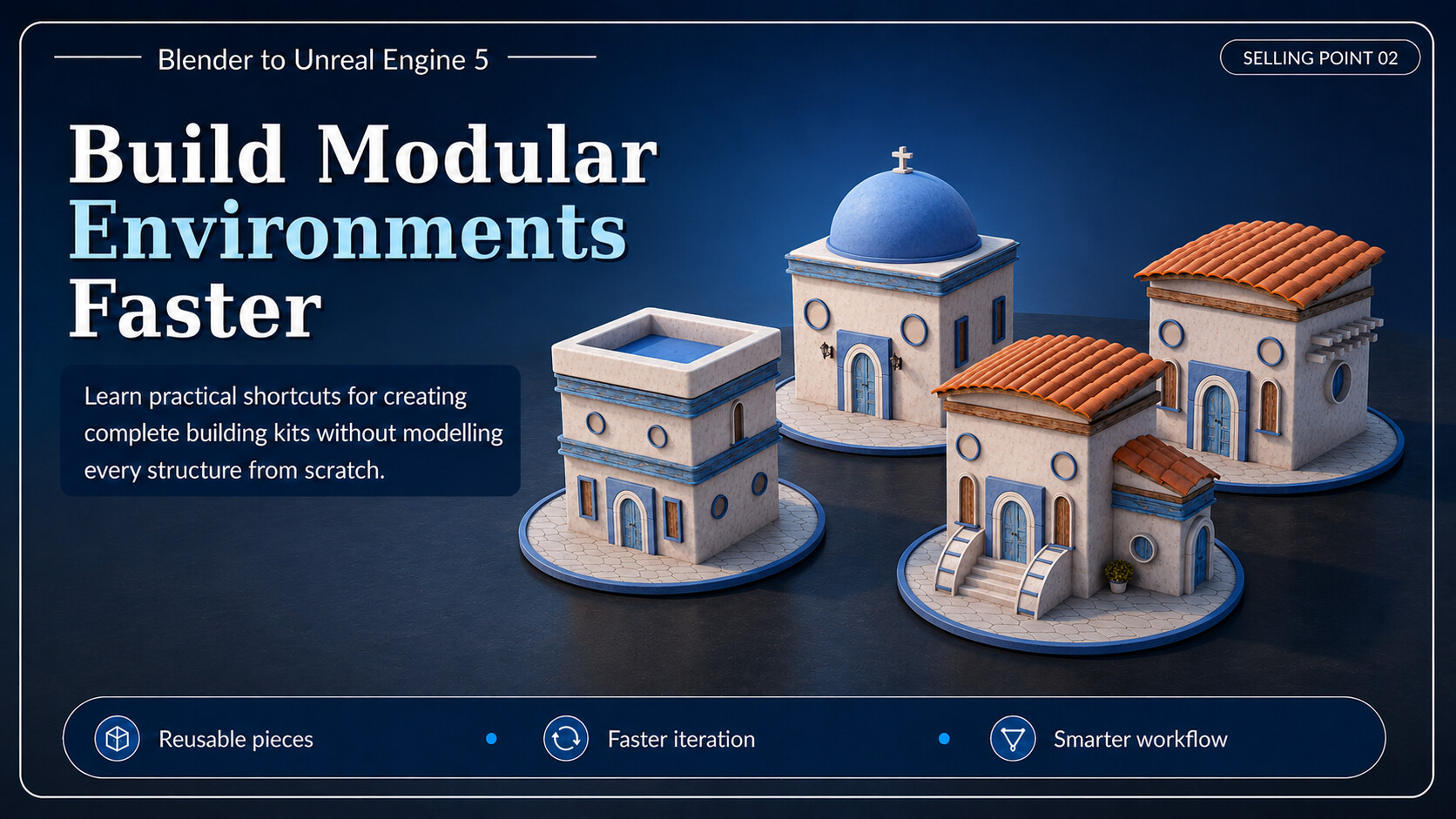
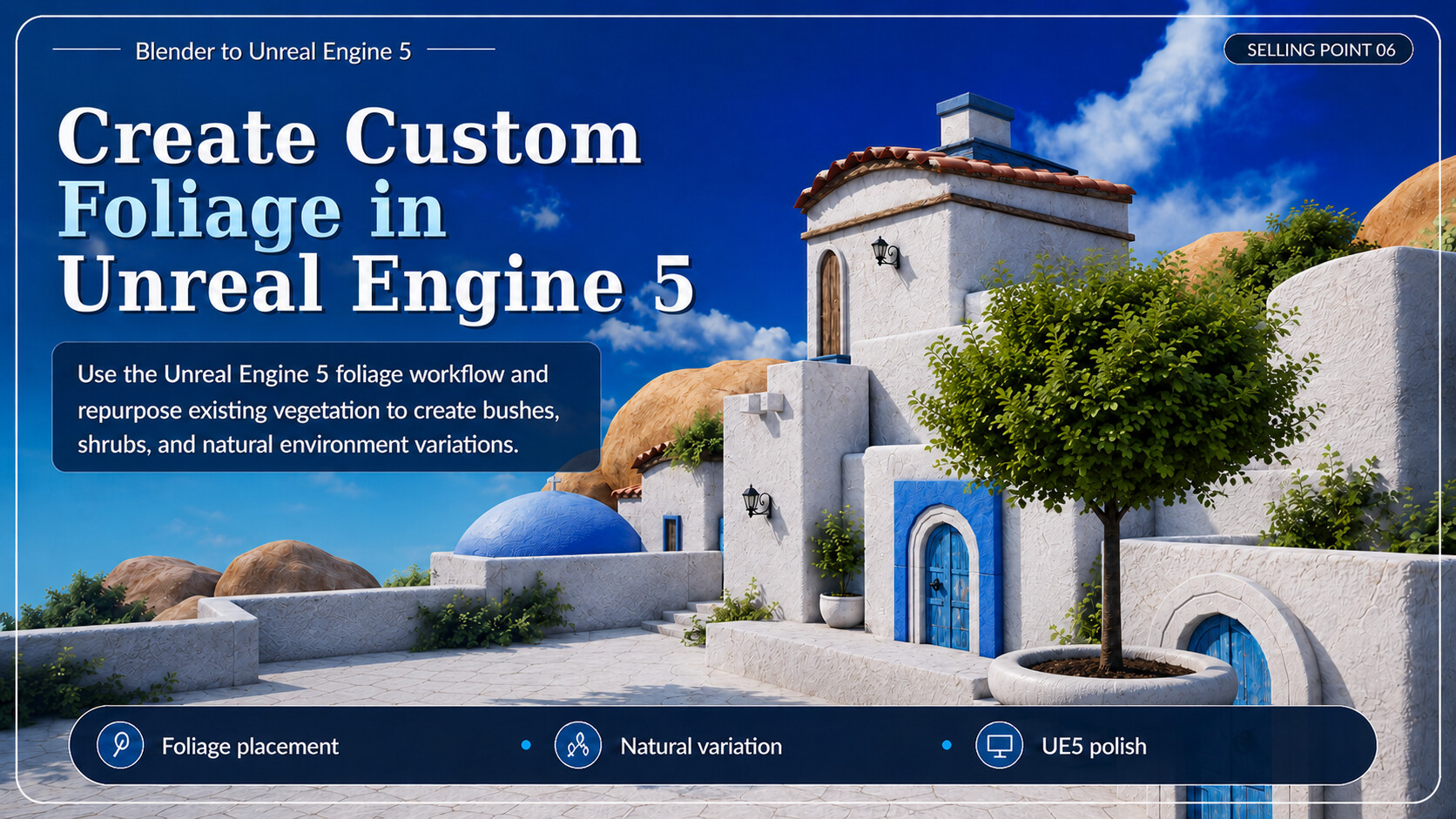
The project is designed around a compact cascading silhouette: white stucco buildings, blue domes and trims, terracotta roof sections, layered stairs and terraces, a clear church focal point, warm rounded rocks, fresh foliage, and a vivid clouded sky.
Rather than treating the village as one fixed model, the course builds a reusable modular system. Buildings, roofs, domes, doors, windows, stairs, platforms, walls, beams, lanterns, pots, rocks, and vegetation are designed as compatible parts, then recombined inside Unreal Engine 5 to create the final scene.
Course SummaryFormat: 60-lesson environment-art course.
Software: Blender and Unreal Engine 5.
Final result: A complete stylized Greek island village assembled, lit, populated, colour graded, and presented in Unreal Engine 5.
Core focus: Modular kit construction, reusable assets, UV and material consistency, clean GLB hand-off, UE5 scene assembly, foliage, lighting, composition, and cinematic presentation.
Best suited to: Confident beginners, intermediate artists, environment artists, indie developers, and portfolio builders.
The Visual TargetThe final environment uses a limited but deliberate visual language:
Sunlit white lime plaster and soft stucco surfaces.
Cobalt and Mediterranean blue domes, doors, windows, trims, and parapet accents.
Warm terracotta roof tiles and curved roof sections.
Light stone paving and exterior stairs.
Peach and sandstone rock foundations that frame the village.
Fresh green shrubs and small trees woven between architecture and rock.
Black-metal lantern accents and subtle glass details.
A high-key daylight setup with a visible sun, bright clouds, warm direct light, cooler blue accents, ambient occlusion, and controlled contact shadows.
Production Workflow1. Reference, scale, and blockout – Establish the Cycladic visual direction, use a human scale reference, block the major buildings, test the camera, and solve the silhouette before committing to detail.
2. Modular building system – Build reusable primitives, floor rings, roof bases, domes, walls, and platforms with clean proportions and repeatable modifier logic.
3. Roof and architectural variation – Create terracotta tile rows, curved roof variants, lattice-deformed roof systems, rounded details, doors, windows, shutters, supports, lanterns, pots, chimneys, and decorative assets.
4. UVs and materials – Use automatic and manual unwrap methods, preserve grain direction, maintain useful texel density, randomise repeated roof UVs, and keep a restrained material family consistent across the kit.
5. Asset preparation and GLB export – Clean names and Collections, apply scale, fix normals, verify origins, preserve separate meshes, export UVs and tangents, and prepare the hand-off for Unreal Engine 5.
6. Unreal import and material setup – Preserve pivots, correct normal-map interpretation, improve tangents, create a custom skybox and sun setup, establish Skylight, fog, exposure, and ambient occlusion controls.
7. Modular scene assembly – Rebuild the settlement from separate pieces, create stepped massing, repeat the dome rhythm, develop the church focal point, shape alleys and courtyards, and refine the camera silhouette.
8. Rocks, foliage, and final presentation – Construct the rocky perimeter through overlap and clustering, repurpose vegetation into shrubs, complete colour grading and cloud-shadow variation, then add a CineCamera and a simple rendered move.
Skills Demonstrated in the Final ProjectEnvironment blockout and large-form composition.
Modular architecture and reusable kit design.
Efficient variation through modifier reuse and asset repurposing.
Procedural and modifier-based roof construction.
UV unwrapping and seamless-material consistency.
Practical origin, pivot, scale, naming, and snapping discipline.
Blender-to-Unreal Engine GLB export and import.
Real-time material readability and ambient occlusion.
Rock massing and vegetation clustering.
Focal hierarchy, silhouette control, and negative space.
Daylight lighting, sky, fog, colour grading, camera framing, and final render output.
Included ResourcesMain Blender resource-pack file.
Prepared materials and example assets.
Reference contact sheets, prop references, building previews, and final visual reference.
Human scale reference.
Stairs Geometry Nodes setup.
Blender-focused hedge Geometry Nodes setup.
Vegetation resources.
Finished Blender-side reference scene.
4K skybox.
Sun plane and sun texture resources.
Completed project resources supporting the full course workflow.
A large asset library is not automatically a useful kit.
The course focuses on the decisions that make the pieces practical: grid-friendly dimensions, predictable origins, preserved pivots, consistent names, separate meshes, controlled UVs, clear attachment points, and forms that remain readable under simple materials.
That makes the final Unreal Engine stage more than an import exercise. It becomes an actual environment-building process, where the layout can be adjusted, repeated, varied, and art-directed without returning to Blender for every small change.
Who This Course Is ForEnvironment artists who want a complete stylized scene for their portfolio and a clear explanation of the workflow behind it.
Blender artists who want to move from isolated modelling exercises into modular world building.
Unreal Engine users who need a stronger understanding of the Blender hand-off, including pivots, tangents, normals, UVs, material response, and mesh separation.
Indie developers and level artists who want a reusable architectural kit rather than one fixed building.
Stylized artists who want to create depth and polish through composition, colour, light, contact, and silhouette rather than excessive shader complexity.
What Makes This Course DifferentThe course does not hide the transfer problems.
You will see why full-scene import tests are useful for validation but limiting for final assembly. You will check UVs, normals, bevels, tangents, material colour, exposure, and pivot behaviour before rebuilding the village from separate pieces. You will also see how simple materials are made to read through controlled lighting and ambient occlusion, and how repeated assets are varied enough to avoid an obvious copy-and-paste result.
The final image is the proof. The reusable pipeline is the lasting value.
Until next time, happy modelling, everyone.
Luke – 3D Tudor
CATEGORIES
Special Offer! Get 20% off when you buy 2 products. Get 35% off when you buy 3 or more products. Applies to all products from this seller only from USD $1.00 to USD $100.00
Standard Use License
USD $24.99
License: Standard License
Stock Assets
For personal use and one commercial project (up to 2,000 sales or 20,000 views).
TutorialsOne copy to be used by a single user.
Installable ToolsOne installation by a single user.
Learn MoreFiles (10)
https://artstn.co/m/BjXY5
Copied
More by 3D Tudor

Add a tip for 3D Tudor
Tips are appreciated, but optional!
